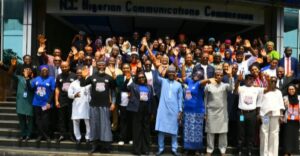
L–R: Director-General of the News Agency of Nigeria (NAN), Ali M. Ali; Director-General of the Federal Radio Corporation of Nigeria (FRCN), Dr. Mohammed Bulama; Managing Director/Chief Executive Officer of the Nigerian Communications Satellite Limited (NIGCOMSAT), Mrs. Nkechi Jane Egerton-Idehen; Director-General of the National Orientation Agency (NOA), Mallam Lanre Issa-Onilu; the Minister of Information and National Orientation, Mohammed Idris, fnipr; Director-General of the National Broadcasting Commission (NBC), Mr. Charles Ebuebu; Director-General of the Nigerian Television Authority (NTA), Comrade Salihu Abdulhamid Dembos, fnipr; and Director-General of the Voice of Nigeria (VON), Mallam Jibrin Baba Ndace, during the Minister’s facility tour of NIGCOMSAT in Abuja on May 13, 2026.
By Peace Udugba
The Federal Government has unveiled a new strategy to fast-track Nigeria’s Digital Switch Over (DSO) programme, with plans to provide up to 100 free-to-air television channels to at least 40l million households across the country.
The Director-General of the National Broadcasting Commission (NBC), Charles Ebuebu, disclosed the initiative during an interview with the News Agency of Nigeria (NAN) on Wednesday in Abuja.
Ebuebu said the government has redesigned the implementation of the DSO project by replacing the previous terrestrial broadcasting model with a satellite-based platform capable of providing immediate nationwide coverage.
According to him, the new approach is designed to bridge existing coverage gaps while enabling millions of Nigerians to access a wider range of television channels and locally produced content without paying subscription fees.
“Our goal is to reach no fewer than 40 million television households across the country. That is the minimum target we have set for this project,” he said.
The NBC boss revealed that the satellite platform is already transmitting more than 73 television channels nationwide, with plans to expand the offering to 100 channels in the near future.
He explained that the previous DSO rollout, which covered only eight states, provided between 24 and 28 channels depending on location and exposed significant shortcomings in the country’s digital migration programme.
According to Ebuebu, the terrestrial broadcasting network covered less than one-quarter of Nigeria despite years of investment. He noted that extending the system nationwide would have required the construction of about 160 transmission towers, the importation of specialised equipment, and several more years to complete.
“After the rollout in eight states, it became obvious that the terrestrial model could not deliver the nationwide coverage we needed. We therefore adopted a satellite-based solution because it provides complete coverage across Nigeria from the very first day,” he stated.
He added that while the NBC will continue to regulate the broadcasting sector, the Nigerian Communications Satellite Limited (NIGCOMSAT) will provide the satellite infrastructure and ground services powering the renewed DSO programme.
Ebuebu further noted that the platform will enable viewers to watch television stations from different parts of the country regardless of their location, a development he said would promote national unity, improve access to information, and increase the visibility of Nigerian content.
He also stressed that the satellite-based system offers significant advantages over the former terrestrial model, including wider nationwide coverage, improved picture quality, and the capacity to carry substantially more television channels.