By Peace Udugba -The daily torch media
U.S. President Donald Trump has said that American and Israeli intelligence agencies confirmed the death of Ali Khamenei, Iran’s Supreme Leader, claiming he was killed alongside key figures of the Islamic regime.
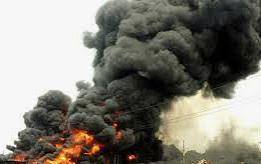
According to President Trump, Khamenei died during coordinated airstrikes carried out by U.S. and Israeli forces on strategic targets in Tehran and other major cities. The Iranian government initially denied the claim and did not provide proof of life for the leader, who had ruled the country since 1989. In a dramatic development, however, Iran’s state broadcaster later confirmed that the Supreme Leader and several senior officials were killed in the strikes on Saturday. Authorities subsequently declared a seven-day national mourning period.
-
The development marks a sharp escalation in Middle East tensions and is expected to carry significant geopolitical consequences.
Life and Times of Ali Khamenei
Born on April 19, 1939, in Mashhad, Iran, Ali Hosseini Khamenei rose from a modest clerical background to become one of the most powerful and longest-serving leaders in the region. Raised in a deeply religious family, he studied Islamic theology in Mashhad before continuing his education in the prominent seminaries of Qom and Najaf, where he was influenced by revolutionary Shiite scholars.
In the 1960s and 1970s, Khamenei became actively involved in opposition to Shah Mohammad Reza Pahlavi. His activism led to repeated arrests and imprisonment. He was a close associate of Ruhollah Khomeini, who led the 1979 Islamic Revolution that overthrew the monarchy and established the Islamic Republic.
Following the revolution, Khamenei quickly assumed key positions in the new government. In 1981, amid political instability and the assassination of senior officials, he was elected President of Iran, serving two terms until 1989. His presidency coincided with the final years of the Iran-Iraq War and efforts to consolidate the new republic.
After Khomeini’s death in 1989, the Assembly of Experts selected Khamenei as Supreme Leader, the country’s highest authority with ultimate control over the armed forces, judiciary and major state institutions. Over time, he consolidated power, expanded the influence of the Revolutionary Guard and strengthened the authority of the Supreme Leader’s office.
Across nearly four decades in power, Khamenei shaped Iran’s domestic and foreign policy, maintaining a firm stance against Western influence, particularly toward the United States and Israel. His tenure was marked by political crackdowns, disputed elections, economic strain and recurring waves of protest, even as Iran sought to assert itself as a dominant regional power.
By the time of his reported death in 2026 at the age of 86, Khamenei had served 37 years as Supreme Leader, leaving behind a complex and controversial legacy that spanned monarchy, revolution, war and prolonged geopolitical confrontation.