By Peace Udugba — The Daily Torch Media
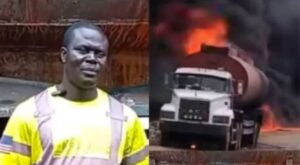
When a fuel tanker caught fire at a busy junction, a 38-year-old driver faced an impossible choice: run for his life or drive the burning truck away from the people in its path.
The first thing many people noticed was the smoke.
It rose into the sky above Feesu Junction, along the Iwo-Ibadan Expressway, thick and dark enough to make residents and motorists stop and look.
Then came the flames.
It was Thursday, September 17, 2026. What had begun as an ordinary fuel delivery had suddenly turned into a potentially deadly emergency.
A fuel tanker was discharging its contents at a filling station opposite Lado Filling Station when flames suddenly erupted from the vehicle.
Around the scene were businesses, homes, motorists and other filling stations. A fire involving a tanker in such an environment needed little imagination to understand what could happen next.
But while people moved away from the danger, one man moved towards it.
His name is Alagbe Hezekiah, a 38-year-old tanker driver from Ogbomoso.
He had a decision to make.
And he made it in seconds.
THE MOMENT EVERYTHING CHANGED
Hezekiah said the fire started suddenly while the discharge pipe was connected to the tanker.
He and his apprentice initially attempted to fight the flames with a fire extinguisher.
It was not enough.
The fire grew.
The extinguisher could no longer contain it, and the danger of leaving the burning vehicle where it was became increasingly obvious.
Then came the decision that would turn an ordinary tanker driver into the central figure in a dramatic story of courage.
Hezekiah got behind the wheel.
Instead of abandoning the burning vehicle at the filling station, he drove it away from the populated area.
“I thought of what I can do to avert putting the lives of many and properties at risk,” he later recalled.
He scanned the surroundings for somewhere with fewer people.
His destination was a riverside.
DRIVING AWAY FROM SAFETY
It is difficult to imagine what was happening inside that driver’s cabin.
Behind Hezekiah was a burning tanker.
Ahead was an open road.
Around him were motorists and residents who had every reason to flee.
Yet he kept driving.
He later explained that he knew the decision could cost him his life.
“I took the bold step with the conviction that I may survive or be consumed and die with the incident,” he said.
It was not a story of a man without fear.
It was the story of a man who acted despite fear.
Hezekiah eventually reached a less populated riverside area and separated the truck’s traction head from the burning tanker.
The fire continued to consume the affected vehicle, but the immediate danger had been moved away from the densely populated area.
Reports from the scene said the tanker suffered severe damage, including its rear tyres. Firefighters later worked to contain the blaze.
Most importantly, no death was reported in the accounts reviewed.
“OUR SAVING GRACE”
For people who witnessed the incident, the significance of Hezekiah’s decision became clearer after the smoke began to settle.
Usain Taoreed, an eyewitness, described the driver’s action as the factor that prevented the situation from escalating to nearby shops, houses and properties.
“Our saving grace was the driver’s courageous effort at driving it to a safe distance,” Taoreed said.
He said there were several filling stations around the area and feared that the consequences could have been worse if the burning tanker had remained at the original location.
Another report noted that thick smoke from the incident could be seen from the direction of Odo-Ori Market, while people in the area moved away from the scene.
The images tell part of the story.
The human decision behind those images tells the rest.
A DRIVER WHO HAD SEEN MANY ROADS
Hezekiah has been driving tanker trucks since 2004.
That means more than two decades behind the wheel, moving heavy vehicles through Nigerian roads and confronting the risks associated with transporting petroleum products.
But experience on the highway could not have fully prepared him for the moment when the vehicle he was driving became the danger.
He said the Iwo incident was the first of its kind he had experienced since he began driving tankers.
For more than 20 years, his job had been to move cargo from one destination to another.
On September 17, his task changed.
He had to move danger away from people.
THE PRICE OF A SPLIT-SECOND DECISION
There is another dimension to the story.
Tanker accidents are not merely road incidents. When fire meets petroleum products, a relatively small emergency can become a major disaster within moments.
That is why the location of the Iwo incident mattered.
The fire started in an area surrounded by human activity.
There were businesses. There were homes. There were motorists. There were filling stations.
Every second mattered.
Hezekiah’s decision did not erase the danger. It placed him directly inside it.
But by moving the burning vehicle away from the more populated area, he created distance between the flames and the people who could have been caught in their path.
That distinction is important.
Courage is not the absence of danger.
Sometimes, it is the decision to act when danger is already present.
THE LESSON BEYOND THE APPLAUSE
With the tanker still ablaze, Hezekiah made another critical move: he detached the trailer head from the burning tank, separating the cab from the fire before moving to safety.
Hezekiah’s story has attracted commendation from witnesses and residents, but the incident also raises uncomfortable questions about emergency preparedness around filling stations and other locations where petroleum products are handled.
How quickly can emergency responders reach such locations?
Are firefighting facilities adequate?
How prepared are tanker drivers and filling-station workers to respond to sudden fires?
And how quickly can people in crowded areas understand that a burning tanker is not a spectacle to watch but a potentially life-threatening emergency?
Reports from the incident showed people gathering near the burning vehicle, even as smoke filled the area.
The bravery of one driver may have reduced the consequences of the incident, but public safety cannot depend on extraordinary individual decisions every time an emergency occurs.
A CALL FOR SAFER ROADS
For Hezekiah, the incident also reinforced another concern familiar to heavy-duty vehicle operators: the condition of roads.
He appealed to the governments of Oyo and Osun states to improve road infrastructure, arguing that better roads would make movement safer for truck drivers and other road users.
It is a reminder that behind every tanker on Nigeria’s highways is a driver navigating not only traffic, but also road conditions, mechanical risks, weather, human error and the enormous consequences that can follow when something goes wrong.
WHEN THE FIRE BECAME A TEST OF CHARACTER
By the time the flames were brought under control, the tanker had been badly damaged.
But the story could have ended very differently.
There could have been casualties.
There could have been destroyed shops.
There could have been damaged homes.
There could have been a wider fire involving nearby facilities.
Instead, the incident ended with a badly damaged tanker and a driver who walked away from a decision that could have cost him his life.
Hezekiah does not describe himself as fearless.
His own account suggests the opposite.
He knew he was afraid.
He simply decided that the lives around him mattered.
That is what makes the story of September 17 more than the story of a tanker fire.
It is the story of a man confronted by fire, fear and an impossible choice — and choosing, in those critical seconds, to put himself between danger and the people behind him.
For the people of Iwo who watched the smoke rise over Feesu Junction that afternoon, September 17, 2026, may long be remembered not only as the day a tanker caught fire, but as the day a driver turned his steering wheel towards danger so that others could move away from it.