By : Peace Udugba
Lagos Governor Advocates Agric Financing at First Bank’s Expo.
Niger State Allocates 100,000 Hectares for Lagos to Boost Food Production.
Nigeria’s agricultural produce is ripe for global competitiveness, but limited access to finance for local farmers remains a major obstacle, hindering their ability to meet international quality and supply standards.
This was the position of Lagos State Governor, Babajide Sanwo-Olu, at the First Bank 2025 Agric and Export Expo, held at Eko Hotels and Suites, Victoria Island, on Tuesday.
The Governor noted that despite Nigeria’s improving crop production, the country’s share of global agricultural exports remains far below expectations. He explained that Nigeria largely exports raw commodities rather than finished products—missing out on the real value chain benefits such as job creation, wealth generation, and industrial growth that come from processing, packaging, and branding.
The event, themed *“The Fundamentals of Building an Export-Driven Economy,”* brought together policymakers, investors, producers, and entrepreneurs to chart a path for diversifying Nigeria’s economy through agriculture and exports.
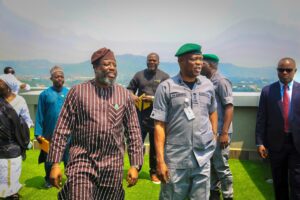
Governor Umar Bago of Niger State also joined Governor Sanwo-Olu at the forum.
Sanwo-Olu emphasized that agriculture offers Nigeria a significant opportunity to grow its GDP, noting that the country is not only blessed with arable land but also with a youthful, energetic population and a resilient entrepreneurial spirit.
The Governor stated that this reality underscores the urgent need for Nigeria to fully harness its agricultural resources and shift from over independence on oil, building instead a resilient economy rooted in productivity, value addition, and global competitiveness in non-oil exports, Sanwo-Olu said:
The economic realities confronting us today—from the volatility of global oil prices, to foreign exchange pressures, and the rising cost of imports—all point to one clear fact: Nigeria must urgently broaden its economic base. We must reduce our reliance on oil and build a resilient economy anchored on productivity, value addition, and competitiveness in non-oil exports, He added:
In Lagos, we have continued to invest heavily in infrastructure—from roads and bridges that connect farms to markets, to the modernisation of our ports and waterways, and digital platforms that simplify trade processes. However, infrastructure alone is not enough. True export competitiveness requires access to finance. Too often, we export raw commodities rather than finished products, thereby forfeiting the real wealth and job opportunities that come from processing, packaging, and branding.
The global marketplace is not waiting for Nigeria,” Sanwo-Olu warned. “Other African nations are actively positioning their agricultural products, securing international market share, and attracting investments into agribusiness. For Nigeria to take its rightful place, we must be intentional, strategic, and relentless in growing our non-oil exports. This is where institutions like First Bank play a vital role—enhancing access to capital for farmers to meet global standards in both demand and quality.
The Governor commended President Bola Ahmed Tinubu’s renewed drive to increase non-oil exports over the past two years, noting that agricultural output had seen an upturn due to increased support to farmers under the current administration.
While acknowledging that quarterly export reports show consistent movement of farm produce to international markets, Sanwo-Olu emphasized that greater economic value would be achieved if more of the exports were in processed or finished form.
Lagos is the launchpad for Nigeria’s engagement with the global economy. Most goods exported from Nigeria pass through Lagos—whether via ports, airports, or logistics corridors. This places a responsibility on us to create an enabling environment for agribusiness, value addition, and export competitiveness. Without access to finance to process farm produce into finished goods, Nigeria will continue to lose real wealth in the global market,” he stated.
Bago emphasized that any nation focused solely on exporting raw products without processing them into finished goods would inevitably be shortchanged in terms of value.
The Niger State Governor noted that adding value to raw commodities allows producers to command global pricing for their goods.
He explained that farmers in Niger State were already benefiting from protein production and dairy supplies, but the State Government is now focused on equipping them with the knowledge and capacity to process raw produce into finished products for better returns from the food market.
“We have begun considering stopping the supply of live cows to the Lagos market,” Bago said. “I plan to terminate the transport of live cattle and goats into Lagos and Ogun states at Mokwa, so that animal waste no longer litters your states. Instead, we will process the meat in Niger State and deliver frozen products to your markets. This is how our farmers can truly benefit from the economic value they generate through cattle rearing.
Bago also announced an expansion of the agricultural land pledged by Niger State to Lagos for mass food production—from 20,000 hectares to 100,000 hectares—to boost output and meet growing market demand.