By Peace Udugba — The Daily Torch Media
The first warning was smoke.
Thick, dark smoke rose above Feesu Junction along the Iwo-Ibadan Expressway on Thursday, September 17, 2026, drawing the attention of residents, motorists and traders.
Then came the flames.
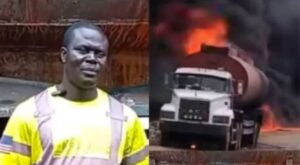
A tanker was discharging its contents at a filling station opposite Lado Filling Station when fire suddenly erupted from the vehicle.
Around the scene were businesses, homes, motorists and other filling stations.
For those watching, the natural instinct was to move away.
For Alagbe Hezekiah, 38, the instinct was different.
He moved towards the danger.
The tanker driver from Ogbomoso was suddenly confronted with a choice that could determine not only his own fate but potentially the fate of people around him.
Should he abandon the burning vehicle where it was, or attempt to move it away from the populated area?
He chose the second option.
WHEN THE FIRE STARTED
Hezekiah said the fire broke out while the discharge pipe was connected to the tanker.
He and his apprentice initially tried to fight the flames with a fire extinguisher.
It was not enough.
The fire intensified.
The longer the burning tanker remained near the filling station and surrounding human activity, the greater the concern became.
Hezekiah then got behind the wheel.
“I thought of what I can do to avert putting the lives of many and properties at risk,” he recalled.
He scanned the surroundings for an area with fewer people.
His destination was a riverside.
DRIVING TOWARDS DANGER
Driving a burning tanker away from a populated area is not a conventional act of safety.
It was a decision taken in an emergency.
Behind Hezekiah was a vehicle engulfed in flames.
Ahead was a road leading away from the immediate concentration of people and businesses.
He drove.
He later acknowledged that he knew the decision could cost him his life.
“I took the bold step with the conviction that I may survive or be consumed and die with the incident,” he said.
The decision was not based on certainty that he would survive.
It was based on his assessment that leaving the burning vehicle where it was posed a greater danger to people and property around him.
He eventually reached a less populated riverside area.
There, he separated the truck’s traction head from the burning tanker.
The tanker was badly damaged, including its rear tyres, while firefighters later worked to contain the blaze.
No death was reported in the accounts reviewed for this story.
“OUR SAVING GRACE”
For eyewitness Usain Taoreed, the driver’s decision was significant.
Taoreed said the driver’s effort to move the burning tanker away from the populated area prevented the situation from escalating towards nearby shops, houses and properties.
“Our saving grace was the driver’s courageous effort at driving it to a safe distance,” Taoreed said.
He said there were several filling stations around the area and feared that the consequences could have been worse if the burning tanker had remained at its original location.
Another account from the scene indicated that smoke from the incident was visible from the direction of Odo-Ori Market, while people moved away from the area.
The images of the burning tanker tell part of the story.
The driver’s decision tells another.
MORE THAN TWO DECADES ON THE ROAD
Hezekiah has been driving tanker trucks since 2004.
For more than two decades, his work has involved moving heavy vehicles and petroleum-related cargo along Nigerian roads.
Yet he said the Iwo incident was the first fire of its kind he had experienced since he began driving tankers.
For years, his responsibility had been straightforward: move the cargo from one destination to another.
On September 17, that responsibility changed.
He had to move danger away from people.
THE QUESTIONS LEFT BEHIND
The incident was dramatic, but the questions it raises extend beyond one driver’s courage.
What emergency procedures are in place when a tanker catches fire during a discharge operation?
How quickly can emergency responders reach such locations?
Are tanker drivers and filling-station workers adequately prepared for sudden fire emergencies?
Are firefighting facilities around fuel-handling locations sufficient?
And why do people continue to gather around burning tankers despite the obvious danger?
Reports from the scene showed people close to the burning vehicle while efforts were being made to contain the fire.
The incident therefore presents two sides of public safety.
There was the extraordinary individual decision made by a driver under pressure.
But there was also a system that should not depend on extraordinary courage every time a tanker emergency occurs.
THE PRICE OF COURAGE
Hezekiah’s action did not eliminate the danger.
It placed him directly inside it.
By moving the burning tanker away from the more populated area, however, he created greater physical distance between the flames and the people around the original location.
That distinction matters.
The evidence does not establish that a major explosion would certainly have occurred if the tanker had remained at the filling station.
What it does establish is that a burning tanker in an area containing people, businesses, motorists and filling stations presented a serious public-safety risk.
And one driver chose to confront that risk.
BEYOND THE APPLAUSE
Hezekiah’s story has understandably attracted praise.
But an award-worthy account should not end with applause.
It should ask what the incident teaches.
His experience points to the dangers faced by tanker drivers and other workers involved in the transportation and handling of petroleum products.
It also highlights the importance of emergency preparedness, public awareness and rapid response.
A driver’s courage can make a difference in an emergency.
But public safety should never depend entirely on finding another courageous driver at the exact moment disaster threatens.
WHEN THE FIRE SUBSIDED
By the time the flames were brought under control, the tanker had suffered severe damage.
Hezekiah survived.
The people around the original location survived.
The incident left behind a damaged tanker, a dramatic trail of smoke and a story that spread through Iwo.
But beyond the spectacle is a simple question:
What makes a person drive towards danger when everyone else is trying to escape it?
For Hezekiah, his answer was the lives and property around him.
On September 17, at Feesu Junction, he faced fire, fear and a rapidly unfolding emergency.
He chose to move the danger away.
That decision deserves to be documented—not simply as an act of heroism, but as a case study in human judgment under extreme pressure and a reminder of the risks surrounding Nigeria’s tanker transport and fuel-handling environment.