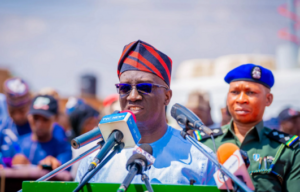
Senator Solomon Olamilekan Adeola (Yayi), Senator representing Ogun West.
By Asiwaju Kunle Kalejaye, SAN — Eagle 102.5 FM, Ilese-Ijebu
The growing debate over the ancestry and indigeneship of Senator Solomon Olamilekan Adeola, popularly known as Yayi, has introduced another dimension to the emerging political contest in Ogun State.
Opponents of the senator have questioned his roots, with claims that his paternal ancestry is linked to Ekiti State rather than Ogun West.
Beyond the political contest, however, the controversy raises a broader constitutional question: to what extent can ancestry or indigeneship determine a person’s eligibility to contest for the office of governor in Nigeria?
The issue requires a careful distinction between political identity, cultural belonging, and the constitutional requirements for elective office.
What Section 177 Says
Section 177 of the 1999 Constitution sets out the qualifications for election to the office of governor.
Among other requirements, a candidate must:
- Be a Nigerian citizen by birth
- Have attained the age of 35
- Be a member of and sponsored by a political party
- Have been educated to at least School Certificate level or its equivalent
Section 182 sets out grounds for disqualification.
Significantly, indigeneship is not expressly listed as a qualification under Section 177.
The Supreme Court has addressed the relationship between Sections 177 and 182 in cases concerning qualification to contest governorship elections. In Alhassan & Anor v. Ishaku & Ors (2016), the Court considered whether complaints about qualification could be determined outside the constitutional requirements contained in Sections 177 and 182.
The Supreme Court had earlier (2016) held that the constitutional provisions on qualification and disqualification for the office of governor are comprehensive.
The legal implication is that where a challenge is specifically based on a candidate’s constitutional qualification to contest a governorship election, the relevant provisions of the Constitution must be carefully identified rather than an additional qualification being assumed from political convention.
Citizenship, Indigeneship and “Belonging”
The controversy becomes more nuanced when Section 318 of the Constitution is considered.
Section 318 defines the expression “belong to” a state, in the constitutional context, by reference to a person whose parent or grandparent was a member of a community indigenous to that state.
The Constitution therefore recognises the concept of belonging or indigeneity in certain circumstances.
But recognising “belonging to” a state is not the same thing as saying that indigeneship is an additional constitutional qualification for election as governor.
That distinction is important in analysing the current controversy.
The appropriate legal question is not merely whether a candidate has ancestral links to another state. It is whether the particular fact being alleged falls within a specific constitutional or statutory provision that applies to the office being contested.
What About Discrimination?
Section 42 of the Constitution protects citizens against certain forms of discrimination on grounds including community, ethnic group, place of origin, sex, religion, and political opinion.
The Supreme Court considered related constitutional questions in Lafia Local Government v. Executive Governor, Nasarawa State & Ors (2012), a case involving a government policy concerning the deployment of local government employees according to their local government of origin. The case concerned discrimination and constitutional rights in the context of public employment, rather than qualification for a governorship election.
That distinction should not be lost.
A judgment dealing with discrimination in public employment cannot automatically be treated as a direct precedent on whether a particular candidate is constitutionally qualified to contest a governorship election.
What If the Ancestry Claim Is Proven?
The central issue surrounding Yayi is therefore different from the question of Nigerian citizenship.
If the argument is that a candidate’s father or ancestors originated from another state, the legal question becomes whether that fact, standing alone, constitutes a constitutional ground for disqualification from a governorship election.
The Supreme Court’s interpretation of Sections 177 and 182 is relevant because the Court has treated those provisions as the principal constitutional framework for determining qualification and disqualification for the office of governor.
This does not mean, however, that questions concerning false information, documentary evidence, nomination procedures, or other applicable electoral laws can never become subjects of litigation.
Such questions would have to be examined according to their specific facts, the applicable law, and the evidence presented before the appropriate court.
Ogun’s Familiar Politics of Ancestry
The present controversy also recalls recurring debates about ancestry, origin, and local belonging that have accompanied political contests in Ogun State.
Supporters and opponents of political figures have, at different times, raised questions about family roots and political belonging.
For Yayi’s supporters, the present controversy may be viewed as an attempt to use questions of ancestry to challenge his political acceptance in parts of Ogun State.
Critics, on the other hand, are entitled to raise questions about identity and belonging in the political arena, provided that allegations are supported by credible evidence and are not presented as established legal conclusions without judicial determination.
That distinction is essential.
Politics and Law Are Not the Same
The court of public opinion operates differently from a court of law.
Political parties, supporters, and voters may debate whether a candidate has sufficient cultural, ancestral, or political connections to a particular community. Voters may also consider a candidate’s record, experience, relationships, policies, and other political factors.
A court, however, determines a legal question by reference to the Constitution, statutes, evidence, and applicable judicial authorities.
Consequently, the legal significance of the indigeneship controversy should be approached with caution.
The precise question is not simply whether Senator Adeola’s ancestry is being debated. The question is whether any alleged fact concerning his ancestry corresponds to a specific constitutional or statutory provision capable of affecting his eligibility to contest the Ogun State governorship election.
On the authorities discussed above, Sections 177 and 182 are central to that inquiry.
Beyond the Ancestry Debate
Ultimately, the controversy raises a broader political question about the issues that should shape the 2027 Ogun State governorship contest.
Should political arguments centre primarily on ancestry and local belonging, or should voters also weigh governance, experience, policies, integrity, development, and other issues?
Those are questions for the electorate.
From a legal standpoint, however, political arguments should not be presented as settled constitutional law unless a court has actually made such a determination.
The indigeneship debate may therefore continue in the political arena. But any attempt to turn the debate into a legal disqualification must still confront the actual provisions of the Constitution and applicable electoral law.
As one commentator reacting to the controversy reportedly put it:
“Even if he be from Zamfara, na my candidate.”
The statement captures the political emotion surrounding the debate, but the constitutional question is different:
What, precisely, does Nigerian law require of anyone seeking to become governor of a state?
That is a question to be answered by the Constitution, applicable laws, and, where necessary, the courts—not by political ancestry narratives alone.