By Peace Udugba
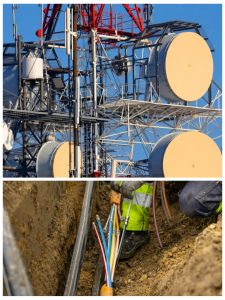
Telecommunications services in parts of Delta State have suffered a major disruption following separate incidents of infrastructure vandalism and fibre-optic cable cuts that forced 103 network sites offline, raising fresh concerns over the quality of service (QoS) across Nigeria’s telecom sector.
The disruption began on July 8, 2026, when robbers attacked an IHS-managed telecommunications facility in the ASB region of Delta State, knocking 33 base stations operating on 2G, 3G and 4G networks out of service.
The situation worsened the following morning after a separate fibre-optic cable cut severed the primary transmission links serving the area. As the affected facility functions as a critical fibre convergence point, the second incident triggered a cascading network failure, increasing the number of affected sites from 33 to 103.
The outage temporarily disrupted voice and data services, digital banking, and commercial activities in several communities across the region, leaving thousands of subscribers without connectivity.
Industry sources said the growing wave of vandalism and fibre cuts is placing enormous financial and operational pressure on Mobile Network Operators (MNOs).
According to the sources, operators have already consumed about 20 per cent more spare parts than budgeted for the current financial year due to repeated emergency repairs. The unexpected demand has depleted technical reserves, making inventory management and financial planning increasingly difficult.
The shortage has also forced engineering teams to divert equipment and materials originally earmarked for new network deployments and expansion projects to restore damaged infrastructure.
Industry experts warned that the development could slow broadband expansion, delay the rollout of new base stations, and reduce anticipated revenue for telecom operators.
The Nigerian Communications Commission (NCC) recently disclosed that telecom infrastructure across the country suffers an average of 1,744 attacks weekly, including more than 1,100 fibre-optic cable cuts.
Stakeholders said operators are also facing lengthy insurance claims processes to recover losses arising from damaged equipment, further compounding the challenge.
The latest incidents have renewed calls for the Federal Government to fully enforce the designation of telecommunications infrastructure as Critical National Information Infrastructure (CNII), arguing that stronger protection is essential to curb vandalism, improve network resilience, and sustain quality of service for consumers nationwide.