By Peace Udugba
The Senate on Wednesday passed constitutional amendment bills seeking to establish state police across Nigeria, marking a significant step toward reforming the country’s security architecture.
The proposed amendments aim to create a legal framework for state-controlled police forces to operate alongside the existing federal police structure.
Supporters say the move will strengthen security, improve intelligence gathering, and enable quicker responses to local threats.
The passage of the bill represents a major milestone in efforts to tackle rising insecurity across the country, including banditry, kidnapping, insurgency, and communal clashes.
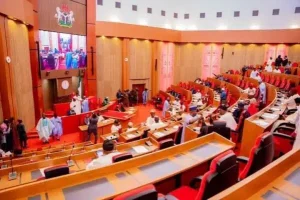
Before the vote, a mild drama unfolded in the Senate chamber when governors, ministers, and other senior government officials sought permission to observe deliberations on the State Police Bill.
Among those in the delegation were Ondo State Governor, Lucky Aiyedatiwa, Kaduna State Governor, Uba Sani, Attorney-General of the Federation and Minister of Justice, Lateef Fagbemi, and the President’s Chief of Staff, Femi Gbajabiamila. Attorneys-General and Commissioners for Justice from Ondo, Anambra, and Akwa Ibom states were also present.
Senate President Godswill Akpabio appealed to lawmakers to allow the visitors into the chamber. Senate Leader Opeyemi Bamidele subsequently moved a motion under Order 1(b) of the Senate Standing Rules, which permits non-members to be admitted under special circumstances.
However, senators initially rejected the motion through a voice vote, prompting Akpabio to make a second appeal. The motion was reintroduced and seconded by Deputy Senate President Barau Jibrin. Despite audible opposition from some lawmakers, Akpabio ruled in favour of the motion, allowing the delegation to enter and observe proceedings.
The incident briefly exposed tensions between some governors and senators, with reports suggesting that certain lawmakers were unhappy with governors accused of influencing the denial of re-election tickets ahead of the 2027 general elections.
For the State Police Bill to become law, it must secure approval from at least two-thirds of the State Houses of Assembly before being transmitted to President Bola Tinubu for assent.