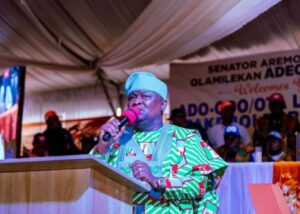
The article was written by Asiwaju Kunle Kalejaye, SAN, Eagle 102.5 FM, Ilese-Ijebu.
The decision by Abba Atiku Abubakar, son of former Vice President Atiku Abubakar, and Olujuwon Obasanjo, son of former President Olusegun Obasanjo, to support President Bola Ahmed Tinubu’s re-election bid in 2027 has reignited debate about political independence, family loyalty and the future of Nigerian democracy.
Their political choices, which differ from the positions of their respective fathers, have been described as an indication that political allegiance should be determined by individual convictions rather than family background.
The development has also attracted legal attention, with Senior Advocate of Nigeria (SAN), Asiwaju Kunle Kalejaye, arguing that the Nigerian Constitution guarantees every adult citizen the right to make independent political choices, irrespective of family ties.
In an article titled “Law Over Lineage: How the Sons of Obasanjo and Atiku Are Challenging Hereditary Politics,” Kalejaye explained that biological relationships and family backgrounds should not determine an individual’s political identity or affiliations.
He maintained that while family heritage may influence personal upbringing, it does not remove an individual’s constitutional right to pursue a different political direction.
According to him, Nigeria’s political environment has traditionally witnessed situations where the political affiliations of prominent family heads influence the positions adopted by other members of their households.
However, he argued that the decisions of Abba Atiku and Olujuwon Obasanjo demonstrate the importance of individual political freedom in a constitutional democracy.
Kalejaye specifically cited Sections 38(1) and 40 of the 1999 Constitution of the Federal Republic of Nigeria, as amended, which guarantee freedom of thought, conscience and religion, as well as freedom of peaceful assembly and association.
He explained that these constitutional provisions protect citizens’ rights to make independent decisions about their political affiliations and associations.
The senior lawyer stressed that adult citizens possess independent legal identities and cannot be compelled to adopt the political positions of their parents or other family members.
He further argued that an individual’s political choices, including party membership and voting decisions, are personal rights that cannot be transferred to or controlled by family heads.
To reinforce his position, Kalejaye referred to judicial pronouncements, including INEC v. Balarabe Musa & Ors (2003), Emeka v. Okoroafor & Ors (2017) and Agbai v. Okogbue (1991), which he cited in discussing the constitutional protection of freedom of association.
He particularly highlighted the principle that freedom of association also encompasses the right of individuals to dissociate themselves from organisations or associations against their wishes.
According to him, the courts have consistently recognised that constitutional rights cannot be overridden by customary expectations or compulsory communal affiliations.
Kalejaye also drew attention to Section 77 of the Electoral Act, which provides for the maintenance of political party membership registers.
He explained that the statutory requirement for political parties to maintain and submit membership registers to the Independent National Electoral Commission (INEC) reinforces the importance of individual membership and participation in party activities.
He argued that political party membership is a matter of individual choice and statutory recognition rather than an inherited family obligation.
The lawyer further invoked Sections 1(1) and 1(3) of the 1999 Constitution, which establish the supremacy of the Constitution and invalidate any law or practice inconsistent with its provisions.
He maintained that no family tradition, political convention or patriarchal expectation can lawfully override the constitutional rights of an adult citizen.
Kalejaye also referenced Section 24 of the Constitution, which outlines the duties of citizens, arguing that responsible citizenship requires individuals to exercise their rights and make decisions in accordance with their convictions.
He described the political choices of Abba Atiku and Olujuwon Obasanjo as an important development in Nigeria’s democratic evolution, particularly as the country approaches the 2027 general elections.
According to him, the development challenges the notion that political loyalty must automatically pass from one generation to another.
He said Nigeria’s democracy would become stronger when citizens are allowed to make political decisions based on their beliefs, convictions and assessment of national issues rather than pressure from influential family members.
Kalejaye concluded that the decisions of the two politicians’ sons offer an important lesson about democratic freedom, insisting that political choices belong to individuals and should not be dictated by bloodlines, family history or inherited political loyalties.
Tags: Atiku Abubakar, Olusegun Obasanjo, Abba Atiku Abubakar, Olujuwon Obasanjo, Bola Tinubu, 2027 Elections, Nigerian Politics, Hereditary Politics, Freedom of Association, Kunle Kalejaye SAN