By Peace Udugba
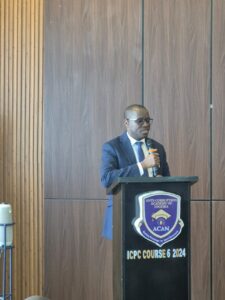
The Chairman of the Independent Corrupt Practices and Other Related Offences Commission (ICPC), Dr. Musa Adamu Aliyu, SAN, has urged public relations officers and journalists to prioritise accuracy, fairness and responsibility in crisis communication and reporting, warning that exaggerated messages about the scale of corruption could inadvertently normalise the practice.
Aliyu made the call on Thursday while delivering the keynote address at the 4th Economic Confidential Annual Lecture and 6th National Spokespersons Awards in Abuja, with the theme, “Anti-Corruption Reforms, Economic Stability and Effective Communication.”
The ICPC Chairman described strategic communication as one of the most underestimated tools in the fight against corruption, stressing that citizens would struggle to support reforms they neither understand nor trust.
Citing guidance from the Basel Institute on Governance, Aliyu said communication that constantly emphasises the widespread nature of corruption could create fatigue and resignation among citizens, reinforcing the perception that corruption is inevitable and that “everyone is doing it.”
He clarified that the approach should not involve downplaying the scale of corruption, but rather combining honest disclosure with practical information that empowers citizens to resist and report corrupt practices.
According to him, communication that is specific, locally relevant and connected to citizens’ everyday experiences is more effective than broad campaigns focused only on the dangers of corruption.
He added that highlighting the “true norm” — that the overwhelming majority of Nigerians reject corruption — could help build confidence and encourage citizens to take action.
Media Critical to Anti-Corruption Campaign
Aliyu said the media occupies a strategic position in Nigeria’s anti-corruption ecosystem, noting that investigative journalism has exposed major corruption cases and contributed to institutional reforms.
However, he stressed that credibility remains one of journalism’s greatest assets.
He urged journalists to uphold accuracy, professionalism, fairness and objectivity, saying these values must take precedence over sensationalism if public trust and democratic accountability are to be strengthened.
On technology, Aliyu said artificial intelligence and other digital tools present significant opportunities for predictive analytics, fraud detection and public procurement monitoring.
He, however, warned that emerging threats, including deepfakes and digital misinformation, require stronger legal and institutional safeguards to ensure that technology remains a tool for transparency rather than becoming an avenue for more sophisticated forms of corruption.
ICPC Tracking 4,582 Public Projects
Aliyu also highlighted some of the Commission’s enforcement and prevention activities.
He disclosed that the ICPC’s Constituency and Executive Projects Tracking Initiative had tracked 4,582 public projects valued at more than N22.53 trillion between 2023 and June 2026.
According to him, the initiative led to the recovery of stalled projects worth N507.04 billion and generated estimated government savings of N385.62 billion.
He added that court-ordered forfeitures had also resulted in the recovery of public assets, including properties worth more than N5 billion linked to the Federal Mortgage Bank of Nigeria and N941.9 million connected to a 2024 payroll fraud scheme.
Aliyu said the achievements demonstrated the importance of evidence-based communication in presenting the impact of anti-corruption interventions to the public.
Integrity Must Become National Culture
The ICPC Chairman also urged stakeholders and policymakers to draw lessons from their educational backgrounds and personal journeys as examples of integrity and responsible citizenship.
He said the Commission was consolidating related school-based interventions into a National Schools Integrity Programme, stressing that while enforcement could address the symptoms of corruption, changing societal values was necessary to tackle its root causes.
“Integrity must become Nigeria’s national culture rather than merely a legal obligation,” he said.
Aliyu commended the National Spokespersons Awards, organised by Economic Confidential, for recognising excellence in public communication, describing effective communication as indispensable to national development.
He said the ICPC had adopted a similar approach in its public enlightenment activities by linking its messages to tangible outcomes and engaging trusted voices, including traditional, religious and community leaders, to strengthen public confidence and encourage citizen reporting.
Aliyu Receives Anti-Corruption Reform Award
In his welcome remarks, the Managing Director of Image Merchants Promotion Limited (IMPR), Mallam Yushau Shuaib, described Aliyu as an advocate of due process and a strong proponent of anti-graft policies and asset recovery.
Shuaib also emphasised the critical role of communication professionals in effective crisis management.
The event, organised by IMPR under its Economic Confidential platform, featured the presentation of a research report on Artificial Intelligence in Crisis Communication in Nigeria.
It brought together government officials, spokespersons, editors, diplomats, security agencies and civil society representatives at the Nicon Luxury Hotel, Abuja.
Aliyu was also honoured with an award for championing anti-corruption reforms, in recognition of his leadership of the ICPC’s enforcement, prevention and public enlightenment efforts.
The ICPC Chairman charged communication professionals to see themselves as “shapers of perception,” stressing that their responsibility goes beyond exposing wrongdoing to helping citizens understand and support solutions.
He called for an anti-corruption campaign built on truth-telling that is “honest enough to be believed, and hopefully enough to be followed.”