By Peace Udugba
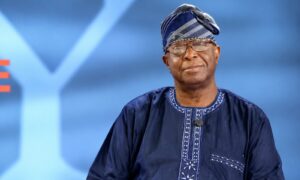
Professor Femi Otubanjo, a Research Professor at the Nigerian Institute of International Affairs (NIIA), has said President Bola Tinubu’s absence from the 81st United Nations General Assembly (UNGA) should be viewed in the context of his ongoing annual leave.
Otubanjo made the remarks on Tuesday while speaking on Frontline, a current affairs programme on Eagle 102.5 FM, Ilese-Ijebu, Ogun State.
He said the debate over Tinubu’s absence should focus on Nigeria’s national interest and the level of representation at the global gathering, rather than solely on the President’s physical presence.
“Majority of people talk without putting it in the proper context. Number one context is that President Bola Tinubu is on his annual leave,” Otubanjo said.
According to him, a president’s attendance at the UNGA is not compulsory, provided the country is appropriately represented.
“The main thing is Nigeria’s national interest,” he said.
Otubanjo noted that Vice President Kashim Shettima is leading Nigeria’s delegation to the 81st UNGA in New York and is expected to deliver Nigeria’s national statement and participate in high-level meetings and bilateral engagements.
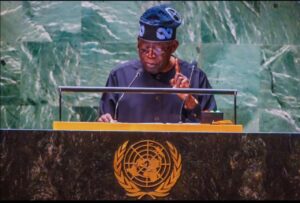
The Presidency confirmed that Tinubu is currently on a working vacation and that he has mandated Shettima to represent him at the UNGA. The President left Nigeria on August 30 for a three-week annual leave and the Presidency announced on September 21 that his stay abroad had been extended by a few days, with his return expected at the weekend.
Otubanjo said the President’s physical presence at international gatherings does not automatically translate into substantive diplomatic engagements.
He argued that some meetings between world leaders at such events could be brief encounters rather than detailed working sessions.
The professor also said diplomatic engagement could continue through established channels, including bilateral discussions and virtual communication.
“COVID taught all of us how to work remotely. The President is talking to his ambassadors and talking to businessmen outside Nigeria,” he said.
Nigeria’s representation at UNGA
The 81st UNGA high-level general debate runs from September 22 to 28, 2026, under the theme, “Restoring trust, managing transformation: A United Nations that delivers for all.”
Shettima is expected to present Nigeria’s national statement and participate in meetings focused on issues including international cooperation, economic development, sustainable development, climate action and reform of the global financial system.
The Federal Government has maintained that Nigeria is fully represented at the gathering and that Shettima is attending with the mandate of the President and the Federal Republic of Nigeria.
The President’s absence has, however, generated public debate, with former Vice President Atiku Abubakar questioning Tinubu’s repeated delegation of the UNGA assignment to Shettima.
‘A nation’s domestic image determines its international image’
Beyond the UNGA controversy, Otubanjo said Nigeria’s international image was closely linked to the country’s domestic governance.
“A nation’s domestic image determines its international image,” he said.
He argued that Nigeria’s growing global visibility meant that developments within the country could easily influence how the nation is perceived internationally.
Otubanjo called for greater emphasis on good governance, accountability, transparency and prudent management of public resources.
He also questioned some areas of government spending, citing expenditures on infrastructure, an aircraft and religious pilgrimage as examples of what he considered misplaced priorities.
“Nigeria has leaders who don’t know how to order their priorities and focus on their people,” he said.
Nigeria’s global ambitions
Otubanjo said Nigeria’s aspiration to retain its influence in Africa and play a stronger role in the international system would require sustained diplomatic engagement as well as credible governance at home.
He noted Nigeria’s interests in institutions such as the African Union and the Economic Community of West African States, as well as its support for greater African representation on a reformed United Nations Security Council.
According to him, Nigeria’s international ambitions should be matched by improvements in governance and the management of public resources.
He maintained that the central consideration in assessing Nigeria’s participation in international engagements should be the country’s national interest and the effectiveness of its representation.