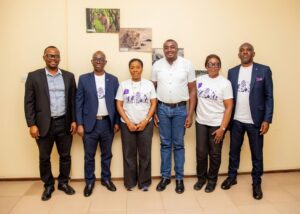
L-R: Director, Communication, Policy and Advocacy, Nigerian Conservation Foundation (NCF), Mr. Kunle Olawoyin; Conservation Educator, National Park Service, Mrs. Ilesanmi Zuliat Hussain; Director, Business Development and Partnership, NCF, Mr. Uchenna Achunine; Chief Brand and Marketing Officer, Union Bank of Nigeria, Mrs. Olufunmilola Aluko; Divisional Head, Corporate Affairs, FCMB, Mr. Diran Olojo; Director, Department of Pollution Control and Environmental Health, Federal Ministry of Environment, Mrs. Olabimpe Adenaike; and Partner, KENNA Legal Practitioners, Mr. Daze Nga at the Nigerian Conservation Foundation Symposium held on June 19, 2026 at the Lekki Conservation Centre, Lekki, Lagos for the commemoration of World Environment Day.
By Peace Udugba
Union Bank of Nigeria, in partnership with the Nigerian Conservation Foundation (NCF), has called for stronger collaboration among governments, businesses, civil society organisations and individuals to address climate change, promote environmental conservation and empower young people to build a more sustainable future.
The call was made during the 2026 World Environment Day Symposium held at the Lekki Conservation Centre in Lagos. The event brought together environmental experts, policymakers, corporate leaders, development partners and students to discuss practical solutions to environmental challenges.
The symposium, themed “Inspired by Nature. For Climate. For Our Future,” focused on environmental sustainability, climate action and the importance of partnerships in tackling the global climate crisis. Participants noted that achieving the objectives of the United Nations Sustainable Development Goals (SDGs), particularly SDG 13 (Climate Action) and SDG 17 (Partnerships for the Goals), requires collective action.
Speaking at the event, Union Bank’s Chief Brand and Marketing Officer, Mrs. Olufunmilola Aluko, stressed that businesses must back their environmental commitments with concrete actions. She noted that financial institutions play a critical role in directing investments that support sustainable development and a greener economy.
“As a bank that has been part of Nigeria’s story for over a century, Union Bank recognises that sustainable development and environmental responsibility must go hand in hand. Businesses have a responsibility not only in what they say but also in what they do. Banks influence where capital flows, and those decisions help shape the kind of economy we build. This is a responsibility we take seriously,” she said.
Aluko added that the bank remains committed to financing initiatives that promote environmental sustainability and responsible economic growth.
Delivering the keynote address, the Director-General of the Nigerian Conservation Foundation, Dr. Joseph Daniel Onoja, described environmental conservation as essential to human survival.
According to him, nature provides the knowledge and resources humanity needs to thrive, warning that failure to protect the environment would ultimately threaten human existence.
“When we talk about nature conservation, we are talking about human conservation because nature will always take care of itself. It is in our best interest to protect the earth and learn from it because it has provided everything we need,” he said.
The event also featured an interactive panel session involving secondary school students from Lagos and other parts of the country. The students advocated greater investment in renewable energy and environmentally friendly technologies while showcasing innovative projects that transformed waste into interior décor and clean energy solutions.
Organisers said the students’ presentations reflected the objectives of SDG 12 on Responsible Consumption and Production and demonstrated the creativity and innovation young people can contribute to climate action.
Union Bank reaffirmed its commitment to supporting initiatives that promote environmental protection, ecosystem restoration and the development of sustainable communities, noting that safeguarding the environment remains central to building a resilient economy for present and future generations.