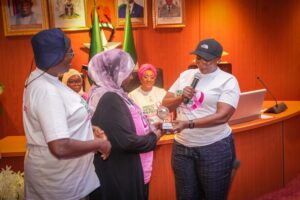
L-R: Minister of State for Health, Prof. Iziaq Adekunle Salako, Governor Hope Uzodimma of Imo State, Imo State First Lady/ Chairperson First Ladies Against Cancer, Barr. Chioma Uzodimma, and Co- Chair of Taskforce on Cervical Cancer Elimination, Dr. Zainab Shinkafi-Bagudu during the flag off of Cervical Cancer Screening Programme’ held in Owerri on April 29, 2026.
By Peace Udugba
Imo State Governor, Senator Hope Uzodimma, has called for stronger public awareness and increased uptake of free cervical cancer screening and HPV vaccination across the state.
Stakeholders at the launch of the campaign agreed that women’s lives can be prolonged if they take advantage of cervical cancer screening initiatives being championed nationwide by First Ladies under the leadership of Oluremi Tinubu.
Speaking at the official flag-off of the Cervical Cancer Screening Programme in Owerri on Wednesday, April 29, 2026, Governor Uzodimma urged communities to leverage technology and grassroots networks to spread awareness. He stressed that cervical cancer is now preventable and treatable, and no longer the death sentence it was once perceived to be.
He encouraged women to utilise the available free services and dismissed fears surrounding vaccine side effects. The governor also commended President Bola Tinubu and the First Lady for supporting cancer control initiatives, including financial backing, while pledging continued collaboration to eliminate cervical cancer through sustained awareness and partnerships.
In her remarks, the wife of the governor and Chairperson of First Ladies Against Cancer (FLAC), Barr. Chioma Uzodimma, described the initiative as “the beginning of a new era of hope and decisive action” against what she called one of the gravest threats to Nigerian women.
Citing 2023 data showing 13,676 new cases nationwide, she emphasised the urgency of action in line with targets set by the World Health Organization on vaccination, screening, and treatment. She also commended the First Lady for a ₦1 billion donation to the national task force, noting that Imo’s selection reflects the state’s commitment to women’s health.
According to her, the programme will expand access to screening, promote early detection, and strengthen treatment systems, urging women to take advantage of the initiative as “early detection saves lives.”
The Minister of State for Health and Social Welfare, Prof. Iziaq Adekunle Salako, said the initiative reflects the Federal Government’s commitment to prioritising women’s health. “No woman should die from a largely preventable cancer,” he stated.
He disclosed that Nigeria has vaccinated over 15 million girls against HPV and introduced national screening guidelines backed by the National Strategic Cancer Control Plan (2026–2030). He commended Imo State’s leadership and urged women, health workers, and community leaders to support awareness efforts.
The Co-Chair of the National Task Force on Cervical Cancer Elimination, Zainab Shinkafi-Bagudu, urged health officials in Imo State to sustain the programme, warning that similar initiatives in other states had faded after political transitions.
“We have done our part; it is now left to you to uplift the women of Imo State,” she said, calling for efficient use of resources and stronger institutional support.
Chairman of the task force, Isaac Adewole, who joined virtually, hailed the rollout of Nigeria’s national cervical cancer training programme, noting that it positions the country as the first in Africa to implement a nationwide scheme of its kind.
He said the first phase will screen about 60,000 women across six states, with plans to expand to local governments and primary healthcare centres nationwide.
The Imo State Commissioner for Health, Dr. Chioma Egu, said the programme would strengthen prevention, screening, treatment, and HPV vaccination across the state. She praised Governor Uzodimma’s leadership and the advocacy of the First Lady, while also acknowledging the support of the national task force.
Dr. Egu urged women to embrace screening and vaccination, stressing the importance of early detection and collective action in eliminating the disease.
Officials noted that cervical cancer claims about 22 lives daily in Nigeria despite being largely preventable, urging women to access screening services and vaccination.
Development partners, including UNICEF, Roche Diagnostics, Bill & Melinda Gates Foundation, and the Nigerian Cancer Society, reaffirmed their commitment to the initiative, describing it as a major step toward eliminating cervical cancer in Nigeria.
They commended federal and state authorities and called for sustained political commitment, community engagement, and expanded access to lifesaving services.
The event attracted wives of state governors, including Hajia Amina Nemadi of Jigawa and Mrs. Titilayo Adeleke of Osun, alongside traditional and religious leaders, legislators, health experts, members of the Imo State Executive Council, and the media.