By Peace Udugba -The Daily Torch Media
Abdul seeks Federal Government’s support for infrastructure, research, technology and staff development as institution prepares for transformation
Yaba College of Technology (YABATECH) has entered a new phase in its institutional history following President Bola Ahmed Tinubu’s assent to the legislation establishing the Federal University of Technology and Vocational Studies, Yaba, Lagos.
The Rector, Dr. Engr. Ibraheem Adedotun Abdul, announced a 10-point development agenda to guide the institution’s transition into a specialised university.
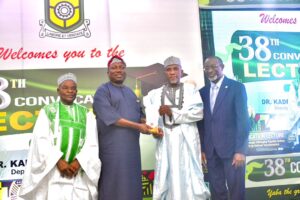
Abdul unveiled the agenda at the institution’s 38th Convocation Ceremony held on Thursday, November 19, 2026, describing the presidential assent as the fulfilment of the College’s 20-year aspiration and recognition of its nearly eight decades of contributions to technological and vocational education in Nigeria.
He said the transition had opened a new chapter of greater possibilities, wider responsibilities and higher expectations, stressing that the transformation must be driven by academic excellence, technological advancement, institutional discipline and collective responsibility.
According to the Rector, the emergence of the Federal University of Technology and Vocational Studies represents a significant development in Nigeria’s higher education sector and underscores the growing importance of technical competence, vocational proficiency, innovation and entrepreneurship to national development.
However, he cautioned that attaining university status would not automatically translate into academic excellence, technological innovation or global competitiveness.
“The true measure of our transformation will therefore not be the designation we carry, but the quality of our graduates, the relevance of our research, the strength of our industry partnerships and the value we contribute to society,” he said.
Abdul outlined 10 strategic priorities for the emerging university. They include developing a distinctive institutional identity, strengthening academic excellence and quality assurance, advancing research and innovation, preserving technical and vocational education, promoting entrepreneurship, investing in human capital, modernising infrastructure, deepening industry partnerships, accelerating digital transformation and pursuing global competitiveness.
He said the institution would be positioned at the intersection of knowledge, skills, innovation and industry, with practical learning, experimentation, technological application and problem-solving forming the foundation of its academic philosophy.
The Rector explained that the new university would prioritise laboratories, workshops, studios, innovation centres and industrial facilities while strengthening the relationship between classroom learning and workplace experience through structured industrial exposure and professional collaboration.
He added that academic programmes would be regularly reviewed to reflect emerging technologies, industry demands and changing societal needs, noting that the future of work required graduates capable of adapting to new occupations and evolving economic opportunities.
According to him, the institution aims to produce graduates who are knowledgeable, technically competent, innovative, entrepreneurial and ethically responsible.
“Our guiding philosophy should be clear: a university where knowledge meets skills, innovation meets industry, and education creates value,” he declared.
The Rector appealed to the Federal Government for sustained investment in academic infrastructure, research facilities, technological equipment, staff development and institutional systems to ensure the successful take-off of the university.
He maintained that investment in technological and vocational education should be viewed as an investment in national productivity, economic resilience and future prosperity.
He added that Nigeria’s industrial and economic ambitions depended largely on developing a highly skilled workforce capable of driving innovation and sustainable growth.
Abdul also highlighted achievements recorded by his administration in infrastructure development, academic expansion, research, entrepreneurship, international collaboration, environmental sustainability and human capital development.
The convocation ceremony also featured the conferment of the College’s prestigious Fellowship on the Minister of Education, Dr. Maruf Tunji Alausa; the Minister of Finance and Coordinating Minister of the Economy, Prof. Taiwo Oyedele; and an alumna, Mrs. Itunu Omotayo.
The recipients were recognised for their contributions to education, public administration, economic development and society.
Established in 1947, YABATECH has remained one of Nigeria’s foremost institutions for technological and vocational education.
The Rector said the institution was committed to preserving its heritage while advancing technological education to meet the country’s changing developmental needs.
He urged stakeholders to see the transition as more than a single administrative event, describing it as a continuous institution-building process that would require sustainable financing, effective governance, appropriate approvals and collective commitment.
He expressed confidence that with the support of the Federal Government, staff, students, alumni and other stakeholders, the emerging university would build on YABATECH’s legacy and strengthen its contribution to Nigeria’s technological and industrial development.