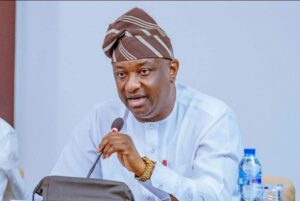
Asiwaju Kunle Kalejaye, SAN, is associated with Eagle 102.5 FM, Ilese-Ijebu.
violence ahead of the 2027 general elections has renewed calls for the establishment of an independent electoral prosecution body to investigate and prosecute electoral offences without political interference.
In a healthy democracy, political campaigns should be won through manifestos, debates and persuasion. President Bola Tinubu, in a statement personally signed on November 13, reiterated this principle, declaring that campaigns should focus on issues and the contestation of ideas that promote the welfare of Nigerians and the progress of the country.
However, political campaigns in Nigeria have increasingly been associated with violence, including machete attacks, destruction of property, injuries and killings.
With the 2027 general elections approaching, recent incidents across several states have raised concerns about the safety of political supporters, journalists and ordinary citizens participating in campaign activities.
In Lagos, armed hoodlums reportedly invaded an event centre in Ikeja, smashing glass installations and injuring journalists and supporters ahead of a town hall meeting organised by Peter Obi’s Nigeria Democratic Congress (NDC).
Similarly, a political procession in Asaba, Delta State, reportedly turned deadly, leaving one person dead and five others injured.
In Katsina State, suspected political thugs allegedly attacked supporters of the All Progressives Congress (APC), injuring several people and setting a vehicle ablaze. Similar incidents were also reported in Enugu, Nasarawa and Ekiti states.
Reacting to the growing incidents of political violence, the President condemned the attacks and directed security agencies to deal decisively with those responsible.
He maintained that violence must have no place in political campaigns as the country prepares for the 2027 general elections.
Existing Electoral Laws Yet to Deter Political Thuggery
According to Kalejaye, what makes the situation particularly troubling is that Nigeria already has legal provisions prescribing penalties for electoral violence and related offences.
He cited the Electoral Act, 2026, which reportedly increased penalties for campaign violence, arguing that the existence of such provisions has not sufficiently deterred political thuggery.
The article referenced Sections 96 and 97 of the Act, which prescribe penalties for threatening political rhetoric and campaign-related violence, while also highlighting Section 227 of the 1999 Constitution and Section 78 of the Electoral Act.
It argued that political thugs continue to operate with confidence because the country lacks a sufficiently independent institution with the investigative and prosecutorial capacity to bring electoral offenders and their sponsors to justice.
Institutional Gaps Fuel Electoral Violence
Kalejaye argued that the current enforcement structure leaves significant gaps in the investigation and prosecution of electoral offences.
According to him, the Independent National Electoral Commission (INEC) is already burdened with electoral administration and logistics, while the police and Attorneys-General operate within an executive-controlled institutional structure.
He questioned whether politically influential individuals and sponsors of electoral violence could be effectively prosecuted when enforcement agencies and prosecutorial authorities operate within the existing political structure.
The consequence, he argued, is a culture of impunity in which arrests are sometimes announced but prosecutions fail to produce meaningful accountability.
In Lagos, for instance, the article alleged that street violence continued for more than an hour before police intervention.
It also referenced the reported arrest of 14 suspects in Katsina, arguing that the investigation should extend beyond the immediate perpetrators to identify those financing and sponsoring the attacks.
Kalejaye further cited a September 2026 Yiaga Africa survey, which reportedly found that 61 per cent of Nigerians, including 78 per cent of respondents in the North-East, feared that violence could prevent them from voting in the 2027 elections.
He also referenced findings presented by Theresa Odinkalu-Okoro, Executive Director of the African Centre for Security, Governance and Development (CentreSGD).
According to the figures attributed to the CLEEN Foundation’s Election Security Threat Assessment, 70 physical election-related attacks were recorded across 19 states and the Federal Capital Territory between January 1 and October 27, 2026, resulting in 27 deaths.
Kaduna, Edo and Enugu were identified as major flashpoints.
Both the Nigeria Civil Society Situation Room, in its November 5 warning, and CentreSGD, in its November 9 assessment, reportedly expressed concern that escalating political attacks could undermine the credibility of the 2027 general elections.
Call for Independent Electoral Counsel
Although President Tinubu has directed security agencies to confront political thuggery and other anti-democratic activities, Kalejaye maintained that presidential directives, legislative hearings and INEC warnings alone would not adequately address the problem.
He called on the National Assembly and the Presidency to establish an Office of the Independent Electoral Counsel, modelled on the proposed Electoral Offences Commission.
According to him, the proposed institution should enjoy security of tenure, independent funding and investigative powers insulated from executive interference.
He argued that an independent electoral prosecutor would be better positioned to investigate cases across states, trace the financiers of political violence and ensure that offenders face prosecution irrespective of their political affiliations.
Such an institution, he added, could also work with INEC to enforce relevant provisions of the Electoral Act against political parties found culpable of electoral offences.
Nigeria Needs Enforcement, Not More Laws
Kalejaye maintained that Nigeria does not necessarily need additional prohibitions to tackle political violence, noting that existing laws already prescribe severe penalties for offences such as arson, murder and online incitement.
He referenced the Criminal and Penal Codes, as well as the Cybercrimes Act, arguing that the challenge lies largely in effective enforcement and accountability.
He also acknowledged the President’s condemnation of political violence and the directive for the prosecution of offenders, describing the next step as the creation of an independent institution capable of translating such directives into sustained action.
He stressed that Nigeria urgently needs an independent prosecutor with the institutional authority and courage to pursue electoral offenders and their sponsors, regardless of their political standing.
According to him, the ultimate objective should be to ensure that elections become peaceful democratic exercises in which every Nigerian can exercise the right to vote without intimidation, violence or fear.
Tags:
Political Violence in Nigeria, 2027 General Elections, Electoral Act 2026,
INEC, Electoral Offences, Kunle Kalejaye SAN, Nigeria Politics, Electoral Reform