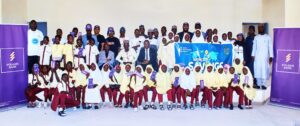
Cross-section of dignitaries and participants at the YESP training programme in Sokoto State.
By Peace Udugba
YABATECH-led initiative validates priority skills, strengthens capacity of training providers
The Youth Employability and Skills Project (YESP), implemented by Yaba College of Technology (YABATECH) in partnership with the Industrial Training Fund (ITF), with support from the United Nations Children’s Fund (UNICEF) and the European Union (EU), has intensified efforts to boost youth employability and promote sustainable livelihoods in Sokoto State.
The initiative recently organised a Stakeholder Consultation and Focus Group Discussion (FGD) on Skills Validation, bringing together government officials, Training Service Providers (TSPs), development partners and other stakeholders to identify, review and validate priority skills needed to address the employment and economic challenges facing young people in the state.
The engagement provided a platform for stakeholders to examine emerging labour market demands, exchange ideas and strengthen collaboration towards providing relevant, inclusive and practical skills training that will prepare young people for employment, entrepreneurship and sustainable livelihoods.
Among the key participants were the Permanent Secretary, Ministry of Basic and Secondary Education, Dr. Sanusi Aliyu Binji; the Honourable Commissioner for Women and Children Affairs, who was represented; the General Secretary of the Joint National Association of Persons with Disabilities (JONAPWD), Sokoto State Chapter, Mr. Mukthar Sanidoki; the Executive Secretary, State Agency for Mass Education (SAME), Dr. Nura Bello Abubakar; and the Permanent Secretary, Skills Acquisition, Arzike Bodinga.
Also present was UNICEF Education Officer in Sokoto, Mrs. Beatrice Sababa, whose participation underscored the importance of strategic partnerships in promoting inclusive and sustainable skills development.
The YESP Project Coordinator, Dr. Funmilayo Doherty, presented the project’s operational framework, outlining its implementation strategy, training delivery expectations, coordination arrangements and accountability mechanisms.
Her presentation provided participants with a clearer understanding of their respective responsibilities and the standards required to achieve the project’s objectives.
Doherty explained that the sessions were designed to equip Training Service Providers with the knowledge and practical competencies needed to deliver quality-assured, inclusive and competency-based training.
She said the programme also emphasised learner protection, institutional accountability and measurable outcomes to ensure that the intervention delivers meaningful benefits to its beneficiaries.
According to her, the project’s focus on gender-responsive pedagogy and the prevention of sexual exploitation and abuse (PSEA) reinforces its commitment to providing a safe and supportive learning environment, particularly for vulnerable young people and persons with disabilities.
She noted that the combination of stakeholder consultation, skills validation and capacity development reflects YESP’s integrated approach to addressing the disconnect between skills acquisition and actual economic opportunities.
Doherty added that engaging government institutions, development partners and training providers would help ensure that the skills being taught align with labour market demands and translate into meaningful employment and business opportunities.
She said YABATECH and its partners were working to strengthen the skills development ecosystem, improve the capacity of training institutions and create sustainable pathways to economic independence for young people.
The project coordinator further stressed the importance of collaboration among government agencies, educational institutions, development organisations and the private sector in tackling youth unemployment and building a workforce capable of responding to changing economic realities.
The training also attracted the Chairman of Rabah Local Government Area, Alhaji Yusuf Muhammad Rabah, who commended UNICEF and the European Union for extending the intervention to Sokoto State.
He acknowledged the importance of development partnerships in expanding opportunities for young people and strengthening grassroots skills acquisition.
Participants also received specialised training in Gender-Responsive Pedagogy (GRP), Prevention of Sexual Exploitation and Abuse (PSEA), Competency-Based Assessment and the project’s Monitoring and Evaluation (M&E) framework.
The intervention is expected to strengthen the capacity of training providers, improve the quality of skills delivery and enhance opportunities for young people to acquire market-relevant competencies for employment and self-reliance.
Tags: YESP, YABATECH, Youth Employability, Youth Skills Development, Sokoto State, UNICEF, European Union, Industrial Training Fund, Skills Acquisition, Youth Employment, Gender-Responsive Pedagogy.