By Peace Udugba -The Daily Torch Media
The Nigerian Content Development and Monitoring Board (NCDMB) and the United Nations Entity for Gender Equality and the Empowerment of Women (UN Women) are exploring joint initiatives to increase women’s participation in Nigeria’s oil and gas industry, with particular emphasis on improving access to a dedicated $40 million financing facility.
The proposed collaboration is expected to strengthen opportunities for women-owned and women-led businesses, improve access to funding and promote greater representation of women across the industry’s value chain.
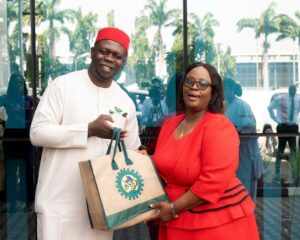
The initiative was discussed on Thursday when UN Women’s Country Representative to Nigeria and the Economic Community of West African States (ECOWAS), Ms. Beatrice Eyong, led a delegation to the NCDMB liaison office in Abuja.
The delegation was received by the Board’s General Manager of Corporate Communications, Dr. Obinna Ezeobi, on behalf of the Executive Secretary, Engr. Felix Omatsola Ogbe.
The $40 million Women in Oil and Gas Fund comprises an initial $20 million facility established by NCDMB in April 2021 and an additional $20 million provided by the Nigerian Export-Import Bank (NEXIM).
The fund was designed to provide financial support to women-owned and women-led businesses in the oil and gas sector. However, despite its competitive lending terms, utilisation of the facility has remained below expectations.
At the meeting, both organisations explored capacity-building programmes for NCDMB personnel to strengthen gender considerations in project planning, budgeting and implementation.
Discussions also covered vendor development programmes to prepare women-led businesses for opportunities in the oil and gas industry, increased awareness of available financing schemes and possible affirmative procurement measures to improve access for women-owned companies.
Eyong commended NCDMB for its existing gender inclusion initiatives, noting that several of the Board’s programmes align with efforts to promote women’s economic empowerment.
She proposed a study to identify the challenges preventing women from accessing the financing facility, including possible difficulties with documentation, business registration, tax compliance and inadequate awareness of the scheme.
The UN Women representative also highlighted programmes being implemented by the organisation in areas such as women’s economic empowerment, leadership development and the elimination of gender-based violence.
In his response, Ezeobi welcomed the proposed collaboration and reaffirmed NCDMB’s readiness to work with UN Women to expand opportunities for women in the industry.
He highlighted the Board’s existing initiatives, including its partnership with NEXIM Bank to establish a dedicated financing scheme offering women-owned and women-led businesses loans at a competitive interest rate of five per cent.
He also cited the establishment of a Diversity Sectoral Working Group under the Nigerian Content Consultative Forum (NCCF), which provides a platform for integrating women’s concerns into local content policies and industry decision-making.
According to him, NCDMB also supports associations of women working across the energy industry’s value chain, providing opportunities for networking, confidence-building, career development and business growth.
Ezeobi further disclosed that the Board had invested in capacity-building programmes for women entrepreneurs and business leaders, focusing on business sustainability, corporate governance and strategic management.
He said the Board was also supporting women’s participation in technical occupations and encouraging young girls to pursue careers in science, technology, engineering and mathematics (STEM).
However, he acknowledged that women remain underrepresented in the oil and gas industry due to challenges including limited access to technical education, financing and commercial opportunities, as well as perceptions that the sector is predominantly male-dominated.
Ezeobi expressed the Board’s willingness to deepen its partnership with UN Women, noting that stronger collaboration would help address these barriers and accelerate gender inclusion across Nigeria’s oil and gas industry.