By Peace Udugba — The Daily Torch Media
The Nigeria Customs Service (NCS) has stepped up its anti-corruption drive as Comptroller-General of Customs (CGC), Adewale Adeniyi, signed key integrity documents and ordered their immediate implementation across all commands, zones and units of the Service.
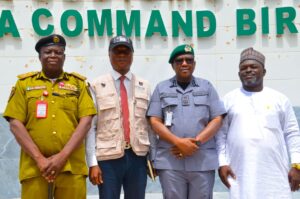
Adeniyi gave the directive on Tuesday, October 6, 2026, at the NCS Headquarters in Maitama, Abuja, during the formal signing of the Standard Operating Procedure (SOP) for Conducting Internal Corruption Risk Analysis and Mapping (ICRAM), the ICRAM Handbook and the Integrity Action Plan.
The Comptroller-General also formally activated the ICRAM Steering Committee, marking a significant step towards institutionalising systematic identification, assessment and management of corruption risks across Customs operations.
According to Adeniyi, the documents were developed through a collaborative process involving an internal NCS team, the World Customs Organisation (WCO) and partner Customs administrations, including His Majesty’s Revenue and Customs (HMRC).
He said the initiative was designed to ensure that integrity remains at the centre of Customs operations.
“These two documents are products of a painstaking process which we have undertaken with efforts from an internal team working together with our partners from the WCO and a number of other Customs administrations that have walked this path with us to ensure that we have a Service where integrity leads,” Adeniyi said.
The CGC explained that the documents would serve as practical tools for Customs officers operating at seaports, airports and land borders to identify corruption risks within their areas of responsibility and implement targeted measures to address them.
“We want to believe that we have laid a practical step, very easy to follow, for all our operatives at the ports, the borders, and the airports, to be able to conduct corruption risk mapping in their places, giving them the opportunity and capacity to implement the action plan to instil integrity in our system,” he added.
ICRAM Pilot Covered 66 Customs Processes
Earlier, the Assistant Comptroller-General of Customs in charge of the Strategic Research and Policy Department, ACG Nafi’u Isyaku, led senior officers in presenting the ICRAM documents and sought approval for their full implementation across the Service.
The ICRAM methodology had earlier been piloted across seven key Customs commands and units, covering 66 processes spanning regulatory, core Customs and support functions.
The pilot locations included the following:
- Sea Modality: Apapa Area Command
- Air Modality: Murtala Muhammed Cargo (MMAC) and Murtala Muhammed International Airport (MMIA) Commands
- Land Modality: Seme Area Command
- Specialised Units: Customs Police Unit Zone A, PAAR Ruling Centre and Procurement Unit
Customs Unveils 101-Point Integrity Action Plan
The pilot exercise resulted in a comprehensive Integrity Action Plan (IAP) containing 101 action items and 295 sub-action items aimed at strengthening accountability and reducing corruption risks within the Service.
The priority areas include increased automation of Customs processes, stronger supervision and accountability, improved audit trails and traceability, clear separation of duties, regular rotation of officers, targeted capacity-building programmes and stronger controls in dealings between officers and stakeholders.
The implementation of the ICRAM framework is expected to provide Customs officers with a structured mechanism for identifying vulnerabilities before they develop into major integrity challenges.
The move also reinforces the NCS’s broader efforts to strengthen transparency, accountability and professionalism across Nigeria’s borders, ports and airports.
Tags: Nigeria Customs Service, NCS, CGC Adewale Adeniyi, Customs anti-corruption, ICRAM, corruption risk mapping, Integrity Action Plan, World Customs Organisation, WCO, HMRC, Apapa Customs, Seme Customs, Nigerian ports, Nigerian borders