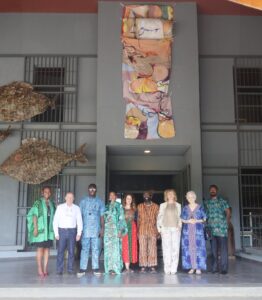
R–L: Dr. Obinna Ezeobi, General Manager, Corporate Communications; Esueme Dan Kikile, Esq., Director, Monitoring and Evaluation; Dr. Abdulmalik Halilu, Director, Corporate Services; Mrs. Jennifer Boateng, Adviser, General Services, GNPC; Mr. Eric Pwadura, Director, Corporate Affairs, GNPC; Mr. Augustine Bayivella, Principal Supply Chain and Local Content Development Officer; and Seidu Salim Braimah, Manager, Supply Chain and Local Content in Yenagoa, Bayelsa State.
By Peace Udugba
The Nigerian Content Development and Monitoring Board (NCDMB) has hosted a delegation from the Ghana National Petroleum Corporation (GNPC) on a knowledge-sharing and local content benchmarking visit aimed at strengthening Ghana’s understanding of local content development policies and implementation strategies in the oil and gas sector.
The delegation, led by GNPC’s Director of Corporate Affairs, Mr. Eric Pwadura, is on a week-long study tour of the NCDMB headquarters in Yenagoa, Bayelsa State.
The team was received on Monday by the Executive Secretary of NCDMB, Engr. Felix Omatsola Ogbe.
Speaking during the visit, Ogbe highlighted Africa’s growing importance in the global energy landscape, noting that the continent currently holds more than 120 billion barrels of crude oil reserves and about 800 trillion standard cubic feet of gas, accounting for over 10 percent of the world’s hydrocarbon resources.
Represented by NCDMB’s Director of Corporate Services, Dr. Abdulmalik Halilu, the Executive Secretary stressed the need for African oil-producing nations to prioritize local content development and reduce dependence on foreign technology for exploration, field development, and production activities.
According to him, Africa’s vast youth population presents a significant opportunity for economic transformation if properly equipped with the technical skills required by the energy industry.
Ogbe traced Nigeria’s local content journey from its origins as a division within the defunct Nigerian National Petroleum Corporation (NNPC) to the establishment of NCDMB as a statutory institution responsible for driving local content development in the country’s oil and gas industry.
He noted that the Board’s Nigerian Content 10-Year Strategic Roadmap is built on five strategic pillars: Technical Capability Development, Compliance and Enforcement, Enabling Business Environment, Organisational Capability, and Sectoral and Regional Markets.
The roadmap is further supported by key enablers, including funding, regulatory support, stakeholder collaboration, and research and development.
Highlighting efforts to build indigenous capacity, Ogbe pointed to the Nigerian Content Intervention Fund (NCI Fund), which is administered through financial institutions such as the Bank of Industry (BOI) and the Nigerian Export-Import Bank (NEXIM). The fund provides single-digit interest loans to local service companies, enabling them to acquire critical assets and improve competitiveness.
He added that NCDMB’s “First Consideration” policy ensures that indigenous companies with proven capabilities are given priority in industry opportunities, thereby encouraging local investments and utilization of developed capacities.
The Executive Secretary emphasized that local content development does not imply a compromise on quality standards.
“Local content does not compromise standards. It does not mean you have African specifications and European specifications. It is one global standard,” he said.
During a presentation on the Nigerian Content 10-Year Strategic Roadmap, Assistant Manager, Strategy and Transformational Projects at NCDMB, Dr. Zuwairat Asekome, reviewed the Board’s progress since the enactment of the Nigerian Oil and Gas Industry Content Development (NOGICD) Act of 2010. She noted that the Board has successfully increased in-country value addition in the industry to 61 percent.
Responding on behalf of the Ghanaian delegation, Pwadura expressed appreciation for the opportunity to learn from Nigeria’s experience.
“Even though we have legislation guiding local content, we have not had the benefit of a robust local content environment like you have,” he said.
He explained that GNPC currently operates a local content unit and is seeking a deeper understanding of NCDMB’s institutional framework and implementation strategies.
Also speaking, NCDMB’s Director of Monitoring and Evaluation, Esueme Dan Kikile, underscored the growing interest among African oil-producing nations in local content development and called for greater collaboration across the continent.
“It is important that we work together. We are happy to continue sharing our experience in oil and gas and local content development,” he said.
Earlier, the General Manager of NCDMB’s Corporate Communications Division, Dr. Obinna Ezeobi, highlighted the longstanding cooperation between Nigeria and Ghana in the energy sector.
He noted that NCDMB has mentored several African institutions on local content development and maintains partnerships with agencies in Ghana, Senegal, Mozambique, Angola, and Namibia.
Other members of the Ghanaian delegation include Mrs. Jennifer Boateng, Adviser, General Services; Mr. Augustine Bayivella, Principal Supply Chain and Local Content Development Officer; and Mr. Seidu Salim Braimah, Manager, Supply Chain and Local Content Development.
The visit is expected to further strengthen regional cooperation and promote the exchange of best practices in local content development across Africa’s oil and gas industry.